
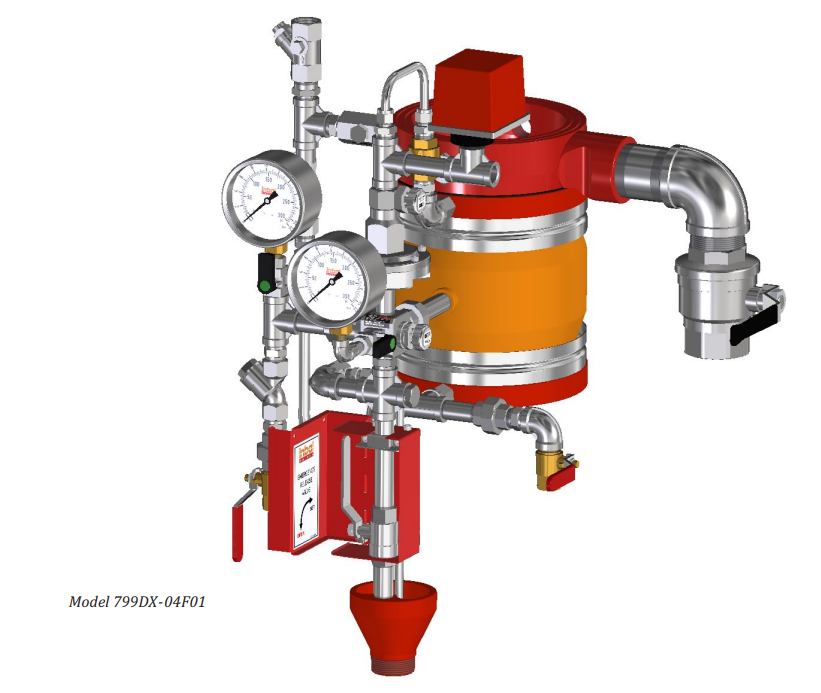
1 – Non-Interlock Pre-Action Systems
The systems are divided into two as Pneumatic Activated and Electric Activated Non-Interlock Pre-Action Valve.
This system is a variant of the normal dry pipe sprinkler system where the water flow from the pre-action alarm valve to the pipe system starts with the opening of the sprinklers or the actuation of an automatic detection system. Regardless of the detection system, a drop in pressure in the pipe causes the pre-action alarm valve to open.
- Non- interlock preaction sprinkler system can be applied where a dry pipe system is required and where fire spread is expected to be rapid. It can also be used in place of dry pipe systems with or without accelerators.
- The actuation method is determined according to the detection system option that is deemed appropriate for use in the area. Actuation can be pneumatic or pneumatic/electric.
Please contact us for Non-Interlock Pre-Action systems.
Pneumatic Actuation Non-Interlock Pre-Action Valve
Pneumatic Actuation Non-Interlock Pre-Action Valve Diagram
Electric Actuation Non-Interlock Pre-Action Valve
Electric Actuation Non-Interlock Pre-Action Valve Diagram
2 – Single Interlock Pre-Action Systems
This system is a variant of the normal dry pipe sprinkler system, in which the passage of water from the pre-action alarm valve to the pipe system starts only when an automatic detection system is actuated. Sprinkler head is closed type. There is no water passage to the pipe system by opening the sprinkler.
- Single interlock pre-action sprinkler system is used in cases where accidental discharge of water may cause serious material damage.
- The actuation method is determined according to the detection system option that is deemed appropriate for use in the area.
- Actuation can be pneumatic or electric.
Please contact us for Single Interlock Pre-Action systems.
3 – Double Interlock Pre-Action Systems
This system is a variant of the normal dry pipe sprinkler system, where the passage of water from the pre-action alarm valve into the piping system starts with the opening of the sprinkler and at the same time actuation of an automatic detection system.
- Double interlock preaction sprinklers are suitable for use where accidental discharge of water would cause serious damage.
- It is the type of system in which the possibility of accidental discharge is minimized because the passage of water into the pipe system occurs in two independent events.
- The actuation method is determined according to the detection system option that is deemed appropriate for use in the area.
- The actuation method can be pneumatic/pneumatic, pneumatic/electric, electric/electric.
Please contact us for Double Interlock Pre-Action systems.
Basic requirements for Pre-Action Systems:
In Non-Interlock and Single-Interlock preaction systems, the system size should be determined so that a maximum of 1000 sprinklers are controlled from the same preaction alarm valve. In double interlocked preaction systems, the system size controlled by a single preaction alarm valve shall be determined in accordance with any of the following items.
- When the test valve at the farthest point is fully opened and the detection system is activated simultaneously, the time taken for the water to discharge should not exceed 60 seconds.
- The system size should be determined using a computer program that calculates the time taken for the water to discharge.
- The calculation program and method should be approved by a nationally recognized laboratory.
- The system size should be such as to provide the values given for the time taken for the water to discharge when flow tests are carried out. Flow tests shall be performed by simulating the number of sprinklers to be opened.
- An accelerator may be used to help meet the requirements of (1), (2) and (3) above.
Which sprinkler types are allowed to be used in preaction sprinkler systems?
- Upright type sprinkler
- Dry type sprinkler
- Horizontal sidewall type sprinkler (In installations fabricated in such a way that no water remains in the pipe)
- Pendent type and sidewall type sprinkler (If sprinklers, pipe lines and branchpipes are located in areas where the temperature is above 4ºC)
The following criteria must be complied with in preaction sprinkler systems.
- The supply of air or nitrogen used to maintain pressure in the piping must be continuously monitored.
- At least one manual discharge station must be equipped to activate the preaction alarm valve in case of emergency.
- Grid piping cannot be used in all types of pre-action systems. In non- interlock and double-interlock systems, the air pressure must be at least 0.5 bar.
- In preaction systems, the air supply source must be continuous.
- The air supply must be capable of filling the system within 30 minutes.
- If more than one dry pipe system is supplied by a single compressor, the largest system should be taken as the basis for 30 minutes filling time.
- For spaces cooled below -15ºC, the filling time can be taken as 60 minutes.
- An automatic detection system should be installed in all rooms and compartments protected by a preaction sprinkler system.
- Detection systems must comply with TS EN54 Standard.
- Where more than one preaction sprinkler system is used, a risk assessment should be carried out taking into account the simultaneous operation of more than one system.
- In case of simultaneous operation of more than one system, the following should be applied:
- The volume of stored water should be increased according to the total preaction system volume.
In multiple systems, the discharge time of water from the test valve at the farthest point should not exceed 60 seconds.


