
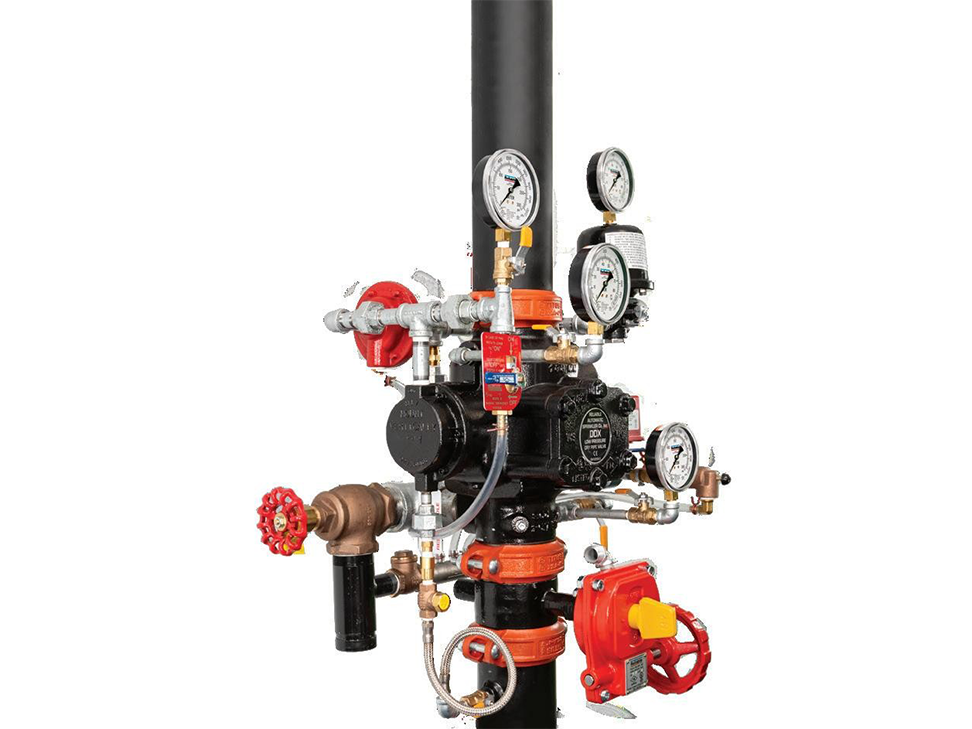
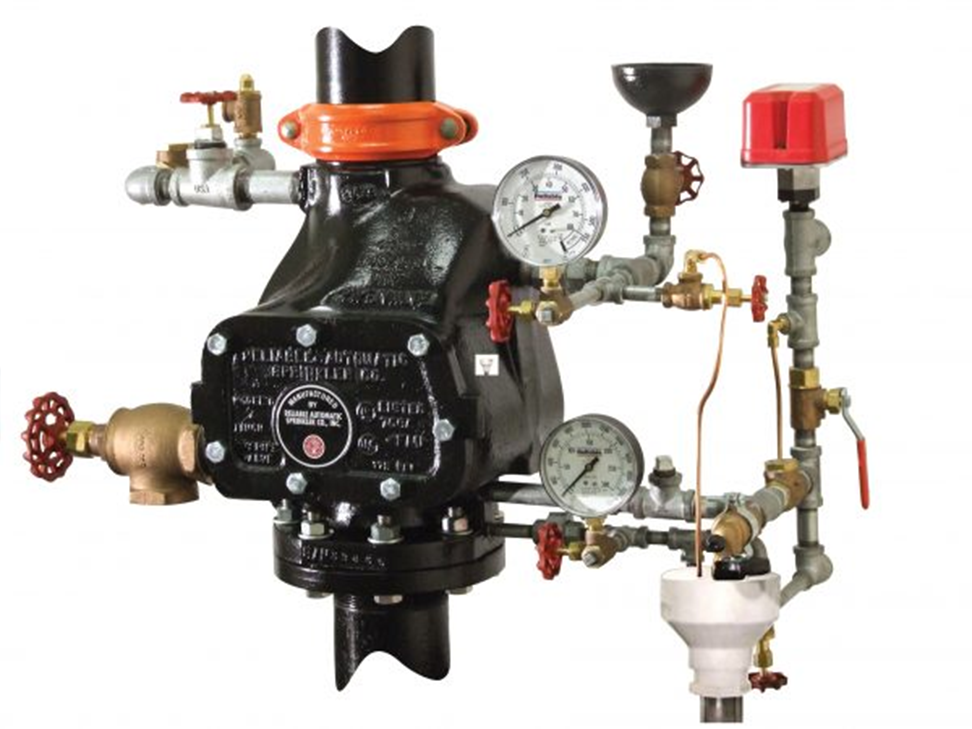
The size of the system controlled by a single dry pipe valve shall be determined in accordance with any of the following points. As an exception, points 3 and 4 are not applicable to residences.
- When the test valve at the furthest point is fully opened, the time taken for the water to drain should not exceed 60 seconds.
- The net pipe internal volume above the dry pipe valve must not exceed the values given in the table below.
|
||||||||||||||
- In systems with a net pipe internal volume of less than 1.5 m³, the use of an accelerator is not required and the time limit for water discharge need not be observed.
- If accelerator is used in systems with a net pipe internal volume of less than 4 m³, the time limit for water discharge does not need to be complied with.
- System size should be calculated with a calculation software depending on the time taken for water to drain. The calculation software and method must be approved by a nationally recognized laboratory. The calculation must comply with the values given in the table below.
| Hazard Class | Number of Sprinklers to be Opened at the Farthest Point | Maximum Water Discharge Time (second) |
| Residential Unit | 1 | 15 |
| Low Hazard Class | 1 | 60 |
| Medium Hazard Class | 2 | 50 |
| High Hazard Class | 4 | 45 |
| High Storage | 4 | 40 |
- The size of the system should be such that, when flow tests are carried out, the values given in the table above for the time taken for the water to drain are achieved. Flow tests shall be performed by simulating the number of sprinklers to be opened. For spaces where a single sprinkler is required to open, the test valve at the farthest point is opened. To simulate a larger number of sprinkler openings, a test manifold arrangement is required. In order to test the 4 sprinklers opening situation; two manifold arrangements suitable for sprinkler flow are made from both branch arms. If the required water discharge times are met by the tests performed, the requirements in Articles 1 and 5 are not required.
In dry pipe systems, grid piping installation should not be used.
It is recommended not to use dry pipe systems in high hazard class applications. The delay in water reaching the first sprinkler can seriously reduce the efficiency of the system.


